Gays, Games, Government and Guns

“For it is time for judgment to begin with God’s household…” 1 Peter 4:17

Another mass-shooting has occurred, so let the finger-pointing begin.

Image

a memorial near Sandy Hook Elementary School in Newtown, Connecticut

James Dobson blames abortion and homosexuality.  Mike Huckabee blames the lack of state-enforced prayer.  Democrats blame the lack of gun laws, and Republicans blame violent video games.

Dobson has an inconsistent view of judgment.  Since God’s judgment begins with the church (1 Peter 4:17), Dobson should have mentioned this when shooters killed worshippers in Atlanta and Illinois.  Huckabee’s remarks do not explain why shooters kill in shopping malls, movie theaters and churches.  Let’s get prayer back in the churches???

Gun laws will work about as well as marijuana criminalization: legislation will not eliminate guns, it will only create underground crime.  Violence in mass media can desensitize us to violence, but the above argument against gun laws apply here: censorship of violent media will also create an underground market.

If Christians truly believe the Gospel, we know that at the core lies a sin problem:

“Their feet are swift to shed blood; in their paths are ruin and misery, and the way of peace         they have not known.” “There is no fear of God before their eyes.” (Romans 3:15-18)

Remembering 1 Peter 4:17, the Church should clean its own house before pointing fingers at others.  Have we been a shining example of a righteous and peaceful society?  Have we reached out to our neighborhoods with the love of Jesus Christ, who died to remove our violent sin nature?  Have we actively opposed societal evil in all of its forms, or do we avoid doing so because it’s too costly or not convenient?

Let’s start with these questions before blaming gays, government and video games.

Posted in Uncategorized | Tagged , , , , , , | 8 Comments

How Important are the Details?

And she gave birth to her firstborn son and wrapped him in swaddling cloths and laid him in a manger, because there was no place for them in the inn. – Luke 2:7

Pope Benedict XVI has written a new book where he looks at the early life of Jesus. You can read about it and see a promo video here.  It’s likely to disappoint or anger some Christians, because he debunks several myths about what happened on Christmas morning.Image

According to the pope’s new book, we’re celebrating Christmas on the wrong date thanks to a 6th century monk’s miscalculation. Also, there is no evidence that animals were actually present for Jesus’ birth, or that the angels actually sang. He has a point about the angels and the animals – the Gospels don’t mention these things.

Benedict does not have a vendetta against Christmas carols and nativity scenes, and I certainly have no intention of removing the animals from our nativity set or banning certain carols from our worship services.

Still, how important is it that we get the story right, down to the very details?

Posted in Uncategorized | Tagged , , , | 5 Comments

Is Church Decline Ever a Good Thing?

Image

Christ Giving the Keys to Peter, Pietro Perugino

“I am the true vine, and my Father is the vinedresser. Every branch in me that does not bear fruit he takes away, and every branch that does bear fruit he prunes, that it may bear more fruit.” John 15:1-2

Do an internet search on the United Methodist Church, and chances are you will see the words “membership decline” in the results.  Since the 1960’s the UMC has experienced a slow and steady decline.  The news isn’t all bad for the UMC –– see this article about how they are growing in Africa. Still, is there anything positive to say about membership decline?

Lesslie Newbigin, an Anglican missionary and bishop, said we must consider God’s big picture.  Read his words with my parenthesis:

“It may well be that for some decades the church will grow rapidly in other parts of the world (Africa), Christians in Europe (or the USA) may continue to be a shrinking minority.  If this should be so, it should be seen as an example of that pruning that is promised to the Church in order that they may bear more fruit (see John 15 above).  When that happens it is painful.  But Jesus assures us, “My Father is the gardener.”  He knows what He is doing, and we can trust Him.” 

He goes on to say that this is not the time for anxiety (perhaps like the kind we see in denominational programs designed to turn things around).  Rather, this is a time for self-searching, repentance, and a fresh commitment.  And we can be sure of this: “he who began a good work in you will bring it to completion at the day of Jesus Christ.” (Philippians 1:6)

Posted in Uncategorized | 5 Comments

The Next Great Religion, and What to do About it.

According to this article, it isn’t a religion at all.  It’s a new category called ‘the Nones.’ 

Image

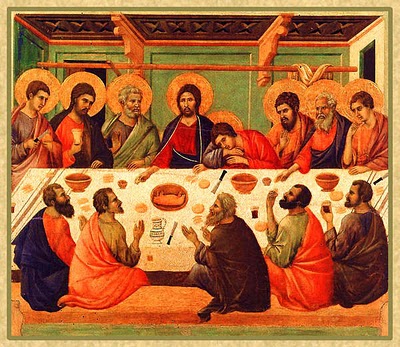
The Last Supper, by Duccio di Buoninsegna

The number of atheists, agnostics, and ‘nones’ are growing.  While this might be scary to many Christians, it has actually been a good thing.  This forces Christians to consider the answers to difficult questions about religion and the existence of God.  In other words, it  keeps us honest.  Or at least it should.

The growth of the ‘nones’ should also motivate Christians to be self-critical: How well are representing our faith in Christ?  Or are we even choosing to represent Christ at all, choosing instead to retreat inside the walls of the church building?

You may not feel equipped to talk with an aggressive atheist or a hardened skeptic, but let me suggest one thing the church can do right now:

There is a saying: People want to belong, not just believe. We were created to be in relationship with others and with God, and yet so many people live in isolation.  Churches can help meet this need. They can offer a sense of belonging and of knowing each other.  Rather than just inviting people to go to church, we should look for ways to help the unchurched belong. This is where table fellowship can be so important.

This is something atheism can never do. Atheism produces organizations, but it does not create community. It might create a sense of shared identity, but this type of ‘community’ seems to be based solely on disbelief and a dislike of religion.  However, give people a place to belong, and you can give them reason to believe.

Posted in Uncategorized | 3 Comments

Is the Church over-confident?

Image

Paul and Silas in Prison, William Hatherell

I am a believer in confidence.  Confidence gives us the inner resources to take those leaps of faith required in Christian discipleship. In the letter to the Hebrews we read, “Do not throw away your confidence, which has a great reward” (Heb.10:35).

And yet confidence can be dangerous.  

Churches can be confident their ability to communicate using the best in marketing, politics, and entertainment.  But instead we need confidence in God and His words, as He speaks to us in Holy Scripture. Churches can be confident in their ability to build successful programs.  But instead we need confidence in the work of Christ in us and His means of grace. Christians can be confident in their own good works.  But instead we need confidence in the righteousness of Christ which we have received by faith alone.  

The Bible reminds us that “the Spirit God gave us does not make us timid, but gives us power, love and self-discipline”(2Tim.1:7).  But where do we place or confidence?  In the kingdoms we are building, or in “the Kingdom that cannot be shaken”(Heb.12:28)? 

Posted in Uncategorized | 2 Comments

Would it matter if Jesus had been married?

Image

The Appearance of Christ to Mary Magdalene, Ivanov Alexander Andreevich

It’s hard to image that 50 years ago women were excluded from ordained ministry.  Now many are wondering if women were excluded from the Bible.  As it turns out, an old scrap of papyrus contains a reference to Jesus’ wife and his female disciples.

The document was written at least 70 years after the Gospels were written, so no scholar would say this proves anything about Jesus.  It does prove that a century after Jesus’ ascension there were legends about his marital status.  You can find articles about this all over the web (this one is interesting), so I won’t repeat those here.  All of this does raise some interesting questions…

Imagine that there is new, indisputable evidence that Jesus was married.  How would this affect your faith?  Could you follow a married Messiah?  Would this matter at all?

Posted in Uncategorized | 3 Comments

Has Kirk Cameron Rejected His “Left Behind” Views?

Monumental, Kirk Cameron’s documentary “seeks to discover America’s true ‘national treasure’: the people, places, and principles that made America the freest, most prosperous and generous nation the world has ever known.”Image

Based on pre-release clips, reviews, and interviews, Kirk Cameron may have changed his mind about the end times. Tim LaHaye’s Left Behind books and movies (starring Kirk Cameron) embrace the end times doctrine of premillennialism. Premillennialism says Christ will return to the earth just prior to a literal one-thousand-year reign. During the time just before the second coming there will be extraordinary tribulation and evil and the appearance of the Anti-Christ.

Monumental seems to reflect the optimism of postmillennialism. Postmillennialism teaches that Christ will return after a millennial period – 1,000 years being understood symbolically. The kingdom of God was established at the Resurrection, and is gradually being realized as Christ’s influence spreads across the globe. Before Christ’s second coming, the world will see a gradual return to biblical norms of justice and righteousness.

Cameron has made no formal statement about his views on the end times, but one things is certain: Monumental is different than the end times perspective taught by the Left Behind series.

Posted in Uncategorized | Leave a comment

Does Daniel Predict the Future? – Go Back in Time, Not Forward

“In the first year of Belshazzar king of Babylon, Daniel had a dream, and visions passed through his mind as he was lying in bed. He wrote down the substance of his dream.” Daniel 7:1

Image

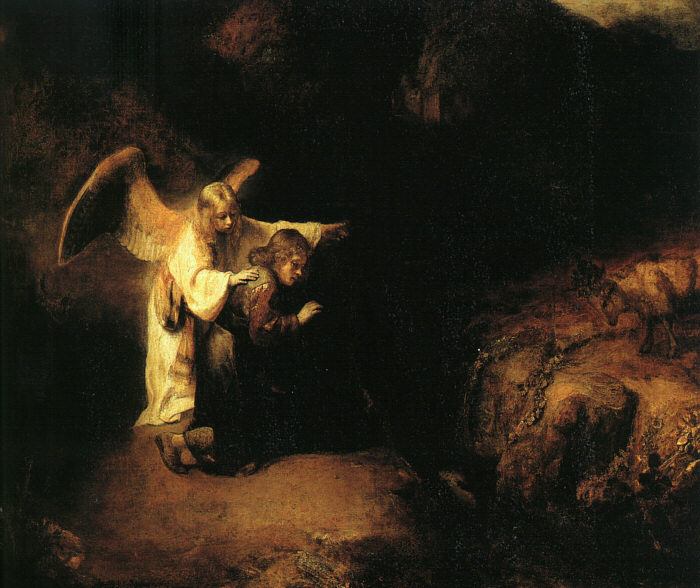
The Vision of Daniel, William Drost

I am back from hiatus, and ready to wrap up this blog series.  I have been suggesting some warning signs, to guard against misunderstanding Daniel’s visions.  

One way we can guard against misinterpreting the images in Daniel is to imagine ourselves as one of the original hearers (or readers).  For example, in 7:13 Daniel sees the son of man riding in the clouds.  This may confuse modern readers, or some may see this as a literal event.  The original audience would have a clearer understanding of this ‘cloud rider.’  

‘Cloud riding’ can be found throughout the Old Testament.  God led Israel through the wilderness as a cloud by day and a pillar of fire by night (Exodus 13:21).  God appeared to Israel in a cloud many times (Exodus 13:21 19:16; Leviticus 16:2).  God is described as a cloud rider in Psalms 68 and 104.  The prophets Isaiah and Nahum also describe God this way.  In fact, many surrounding cultures described their gods as cloud riders.  

The point here is that while certain images may at first confuse us, they often made sense to the original hearers.  

The lesson here is that Bible interpretation often requires some homework.  There are resources to help us understand Scripture in its original context: commentaries, study Bibles, pastors and teachers.  Still, the basic message of Daniel’s visions can be understood by all modern readers: Even when it looks like evil controls the world, God is in control and will win the struggle.  

Outlandish speculations and predictions are all too common.  To prevent these, it helps to remember that these images and language come from ancient history. 

Posted in Uncategorized | 4 Comments

Does Daniel Predict the Future? Understanding Numbers

The caution against interpreting images also applies to numbers, which are often used in a symbolic manner.

Image

The Archangel Michael defeating Satan – Guido Reni

Whether it be the “time, times, and half a time” of Daniel 7 or the “seventy weeks” of Daniel 9 or the one thousand years of Revelation 20, the original readers would probably have recognized some of these as symbols, and not literal figures.  This is the nature of apocalyptic literature. 

Take, for instance, the seventy weeks (or seventy sevens) of Daniel 9. Is this 490 literal years? If so, where does this fit in history? Antiochus Epiphanes? The first or second coming of Jesus Christ? The Roman Empire? Take your pick, or choose from a dozen or so interpretations.

These interpretations of the seventy weeks all have one thing in common: they can distract us from the primary message of Daniel’s visions: God has determined the time when He will put an end to sin and suffering. 

Posted in Uncategorized | Leave a comment

Does Daniel Predict the Future? Understanding Images

“While I, Daniel, was watching the vision and trying to understand it, there before me stood one who looked like a man. And I heard a man’s voice from the Ulai calling, “Gabriel, tell this man the meaning of the vision.”(Daniel 8:15-16)

Image

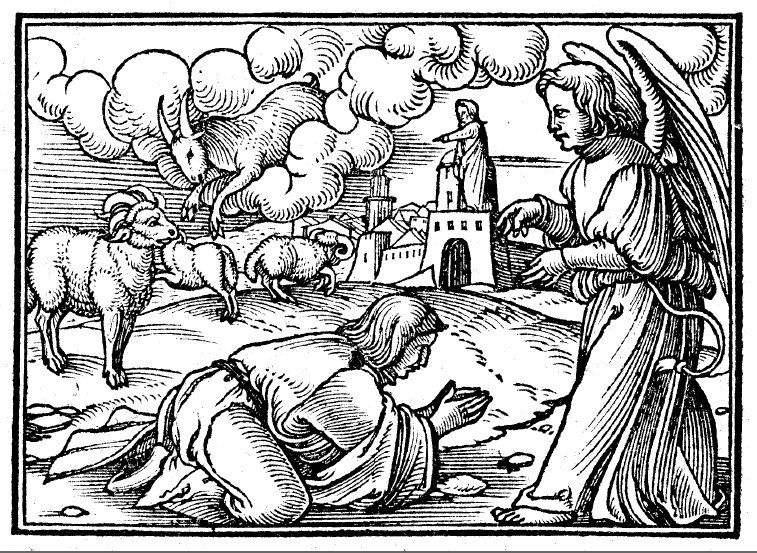
Vision of the Ram and Goat, Zurich Bible

When reading Daniel 7-12 or Revelation, our first question should be “What did this mean to the original readers?”, not “When will these things happen?”

Apocalyptic literature, like Daniel 7-12 and Revelation, frequently uses images. In Daniel 7, God is an ‘Ancient of Days,’ sitting as a judge on a throne. To the original readers this would not be a literal description of God. God is not an old man sitting on a physical throne. The same would have been true of hybrid beasts or the Son of Man: the original readers would not have understood these literally, but as images pointing to greater realities.

If we try to interpret the images of Daniel 7-12 and Revelation literally, we are headed for confusion and misinterpretation.  This does not mean we can’t understand Daniel’s or John the Revelator’s images at all, but understanding these images will require more work than your typical Bible study.  We will get a glimpse of the future when we carefully study apocalyptic literature, but we will also see some ‘gray areas.’

Posted in Uncategorized | 2 Comments