A Theology of Bowling

As silly as it sounds, bowling can illustrate biblical truths. Here are a few theological reflections on a recent outing with the Susquehanna Charge youth:

Do not rely on previous victories.

I easily broke triple digits the last time I bowled, so I felt pretty confident that I wouldn’t embarrass myself in front of a group of teenagers. My confidence, which was based on past success, was misplaced. I broke the 100 mark only once – thanks to a youth who graciously rolled a strike for me.

Douglas Rosa's 'Elijah' in The Living Story of the Old Testament.

‘Elijah’ in Douglas Rosa’s Living Story of the Old Testament

In Joshua 7, Israel’s defeat at the hands of Ai stands in striking contrast to their military victories of the previous six chapters. The thrill of victory over larger nations like Jericho was quickly replaced with the agony of defeat. One moment we can be like Elijah standing victoriously on Mount Carmel and the next hiding in a cave in deep despair (1 Kings 19:10).

Success requires persistent discipline.

Anyone looking at the scorecard could easily distinguish between those with a disciplined routine of bowling, and those who bowl annually. Who invited those league bowlers anyways?

With the outpouring of the Spirit in Acts 2, thousands of people believed in Christ, and the new Church took on a disciplined way of life. The believers devoted themselves to daily study, prayer, fellowship and service. As a result, “the Lord added to their number day by day those who were being saved (Acts 2:47).”

Do not make rash vows.

I promised to buy ice cream for anyone who could outscore me. I do the same at miniature golf outings, and I sometimes end up buying an ice cream or two. I quickly lost count of how many times I was out bowled, so I am now preparing a few batches of home made vanilla ice cream for the next youth activity.

In the words of Solomon, “It is a trap to dedicate something rashly and only later to consider one’s vows (Proverbs 20:25). Just ask the warrior Jephthah. He vowed to offer as a burnt offering to God the first thing he saw coming out of his house, which turned out to be his daughter (Judges 11:30).

(Bible commentary: I believe that Jephthah did not sacrifice his daughter as a burnt offering, but devoted her, as a virgin, to the service of God for the remainder of her life.)

Fortunately I learned these important lessons in the context of fun, which brings me to one final reflection: Jesus had fun. He went to a wedding in Cana and a dinner party at Matthew’s house. His critics accused him of eating and drinking too much (Matt. 11:19).

Jesus is still looking for a good party, he’s just waiting for an invitation: “Behold, I stand at the door and knock. If anyone hears My voice and opens the door, I will come in to him and dine with him, and he with Me” (Revelation 3:20)

Posted in Bowling, christianity, Elijah, Elijah, Jephthah, Old Testament, Proverbs, Uncategorized | Tagged , , , , , , , , , , , , | 1 Comment

Do I Really Need Coffee?

Our desires and habits are not set in stone. Like many, I think a morning coffee is enjoyable, but I won’t go so far to say that I need it to function in the morning. Thirty days without it and I will probably be fine, because in reality it is a habit, not a need. This is true for many of our bodily cravings, although some are more powerful than others.

Ezra in Prayer - Gustave Dore

Ezra in Prayer, by Gustave Dore

As I prepare a sermon about Ezra, a priest who led Jews back to Jerusalem, I’m seeing how two simple words can change the way we think about fasting and physical pleasure.

The exile was over, and King Artaxerxes of Persia’s decree allowed the Jews to return, but they had to do so without government protection. Understandably, Ezra was afraid and sought God’s help:

“I proclaimed a fast, so that we might humble ourselves before our God and ask him for a safe journey for us and our children, with all our possessions” (Ezra 8:21).

Notice those the words in bold. Fasting is not an expression of humility before God, but according to Ezra it makes true humility possible.

Fasting enables us to acknowledge that our love for physical pleasure often exceeds our taking pleasure in God. Fasting reminds us that “life is more than food” (Luke 12:23), and that it is God who “satisfies the thirsty and fills the hungry with good things” (Psalm 107:9).

Fasting makes us humble before God, and it also helps us differentiate between needs and bodily cravings.

Posted in christianity, Ezra, fasting, Old Testament, Persian Empire, Uncategorized | Tagged , , , , , , | Leave a comment

Should Christians Protest?

It’s hard to find a biblical model of public protesting. Unlike modern Western democracies, public protesting against Babylonian, Persian or Roman policies was pointless and likely resulted in swift punishment…such as a trip to the lion’s den.

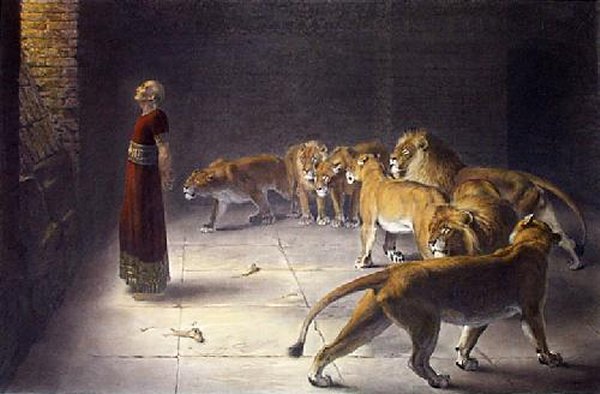
As I preach on Daniel, it’s hard not to think of the lion’s den and Daniel’s form of protesting that helped put him there.

Briton Riviere (1840-1920), Daniel's Answer to the King

Daniel’s Answer to the King, by Briton Riviere

While many Jewish exiles were relocated back to their homeland (Daniel 6), Daniel remained an influential part of Persian society (vv.6:1–3), which made his political rivals jealous. Knowing Daniel’s devotion to God, they convinced King Darius to establish a law mandating that only prayers offered to him would be legal (vv.6-9).

Daniel’s open refusal to comply with the new law can be misunderstood as a public protest. When Daniel prayed to God, he was not instigating confrontation with Persian authorities, he was just continuing his established pattern of faithful prayer to God.

I’m not saying that public demonstrations can never be a form of Christian witness, but Daniel shows us how consistent, disciplined discipleship is our best testimony against any ungodly demands of the state. Daniel was recognized by his enemies for his disciplined prayer life, so when that was outlawed he was easy to find.

How well do we stand out?

Posted in christianity, Old Testament, Persian Empire | Tagged , , , , , , , | 2 Comments

Searching Far and Wide for Virgins

As I prepare a sermon on Esther, I am reminded of the Persian Empire’s ill-treatment of women and Jews. Queen Vashti is deposed because she refuses to be king Xerxes’ entertainment. Esther, a Jewish woman, is forced to become a member of the king’s harem. The Jews, already marginalized due to their status as exiles, face annihilation due to a policy written by a hate-filled member of the nobility.

Esther is written in a context of nationwide suffering, and yet the author still adds humor and suspense to the story, and provides the reader with a hopeful ending: Esther becomes queen, God’s people are rescued and their persecutor is exposed and executed.

Esthermillais

‘Esther’, by Sir John Everett Millais

But there is one detail that caught my attention for the first time: where does Xerxes get his new queen? His advisors have an idea:

“Let the king appoint commissioners in every province of his realm to bring all these beautiful young women (many translations render the word ‘virgins’) into the harem at the citadel of Susa…Then let the young woman who pleases the king be queen instead of Vashti.” (Esther 2:3-4)

Xerxes ruled 127 provinces, from India to the Nile region (Esther 1:1). By any society’s standard, this is an insane abuse of authority. It’s a waste of resources in an overextended empire. It’s a terrible policy with painful consequences for thousands of families.

And yet God used this horrible situation created by foolish leaders to save His people.

Herein lies an easily overlooked lesson in the story of Esther: God can make excessive government intervention – both domestic and foreign – serve the purposes of His kingdom.

Posted in christianity, Esther, interventionism, Old Testament, Persian Empire, Xerxes | Tagged , , , , , | Leave a comment

Is the Church in Exile?

The people of God throughout biblical history have been a people of exile. Whether it was under the Assyrians, Babylonians, Greeks or the Romans, Israel had to learn how to be a holy people in alien lands and under foreign rule.

Featured image

The Flight of the Prisoners, James Tissot

Although Christianity was originally a small, persecuted Jewish sect, for much of its history the Church has enjoyed (and often abused) considerable influence and power, and its people have lived with a sense of being at home in the world. That age, known as Christendom, is now over, even in North America where the presence and influence of Christianity had been everywhere.

Christians no longer hold a monopoly in political affairs. Personal world views, religions and societies are no longer rooted in the language and assumptions of Christianity. The church has lost its place of privilege in society. For these reasons, ‘exile’ has become a popular word used to describe the situation of the contemporary church.

Exile describes a situation where one is being forced and removed from the familiar and comfortable, estranged from one’s home. It remembers a previous establishment, and hopes for the restoration of that establishment. Like the Israelites who longed for their lost kingdom, many Christians long for the Church’s lost status.

Properly understood, the exile reminds us that God has not abandoned the Church. God does not offer us a return to how things used to be, but instead reminds us of our call to embody something better: the Kingdom of God.

Posted in Uncategorized | Tagged , , , | 1 Comment

The Horror of War (Even the Biblical Ones)

Whenever we read or hear about war in the news, we shouldn’t ignore its terrifying realities. War results in the taking of human lives by other human beings. The soldier dying in the battlefield is killed by a person who never knew him personally. Civilians are killed because they live in a place where soldiers drop bombs. Wars also result in long-term damage to homes, cities, and economies. American soldiers and Vietnamese citizens still suffer the effects of Agent Orange.

Image

Joshua’s Victory over the Amalekites, by Nicolas Poussin

I am a spectator when it comes to war. I can watch graphic documentaries or listen to a disabled veteran tell his story, but I will never appreciate the full impact of war. However, recognizing its horrific consequences can change the way I read history or a newspaper.

Such awareness can also affect the way I read the Bible. There we read of wars being used as instruments of God’s judgment on people who oppressed weaker nations and practiced unrestrained forms of paganism that involved such things as child sacrifice (Deuteronomy 13:12-17). We also read of wars being used as tools to accomplish God’s overall redemptive purposes. The Old Testament narrative tells the story of how God replaced wicked nations with a holy nation, one that would bless the entire world (Genesis 12:3; Deuteronomy 4:1-8).

The Old Testament rationale for war does not make me cheer when I read about how thousands of men are killed, their wives are taken by Israeli victors, their property is destroyed and entire nations are either obliterated or displaced. These are somber realities of war. Even if we consider wars to be just and necessary, they still lead to unmitigated suffering.

This includes the Biblical ones.

Posted in Uncategorized | Tagged , , , , | Leave a comment

The Stench and Filth of Maundy Thursday

“…what I lost I think of as sewer trash, so that I might gain Christ”(Philippians 3:8).

Jesus washed his disciple’s feet on Maundy Thursday. There was so much drama around the dinner table that night that we can easily overlook this part of the story. In John’s Gospel, Jesus takes off his robe, wraps himself in a towel like a slave, and washes the feet of his disciples.                                                                           

Image

Jesus Washing Jesus’ Feet by Seider Koder

Movies and artwork usually do not give an accurate picture of how dirty streets were in the ancient world. People dumped their garbage and human waste in the streets, and people walked through it. When dinner guests arrived they reclined at the table, while the lowliest person in the household washed off the waste and garbage that was on their feet. 

In Philippians 3:8, the verse quoted above, Paul uses the Greek word skubalon – which appears only once in the New Testament. Most modern translations use the word ‘rubbish’ or ‘garbage,’ but I like how the Common English Bible translates the word as ‘sewer trash.’

Jesus didn’t just wash the dust from his disciples’ feet – he washed off the garbage – and perhaps even the human dung. He didn’t shy away from the really disgusting work. While Holy Week is a time for contemplating on the benefits of Christ’s death, let’s not ignore the lessons of his life. 

Posted in Uncategorized | Leave a comment

Did the Apostle Paul have Epilepsy?

I was diagnosed with Epilepsy when I was 5th grade, and have been taking anti-seizure drugs ever since. I continue to experience the peaks and valleys of having a chronic medical condition. Medication that works as a teenager may not work as an adult.

Image

Paul in Prison by Rembrandt

Or it may cause side effects.

When I was 18 years old, God began to push me in exciting new directions. I dove headfirst into church life, and I found myself waking up at night and reading Scripture and praying. One night I read the following passage from Paul:

“I was given a thorn in my body because of the outstanding revelations I’ve received so that I wouldn’t be conceited. It’s a messenger from Satan sent to torment me so that I wouldn’t be conceited. I pleaded with the Lord three times for it to leave me alone. He said to me, “My grace is enough for you, because power is made perfect in weakness.” (2 Corinthians 12:7-9)

Whenever my epilepsy raises its ugly head, I remember this passage, because some historians have suggested that Paul may have had epilepsy. (Acts 9:3-9; Galatians 4: 13-14). I’m not certain that Paul had epilepsy, but even the suggestion helps me remember 2 Corinthians 12. Paul knew what it was like to have a chronic medical condition. It didn’t stop him from traveling the Roman Empire and planting churches, but it was severe enough for him to plead with God to take it away. Some days I think I know how he felt. I don’t have seizures of the “fall down and convulse” variety. I do have simple partials and sometimes even complex partials. They don’t keep me from functioning as a pastor, but they are serious enough that I wish to God they didn’t happen. And yet they sometimes do. Until the day I am completely seizure free, I must remember God’s promises to the afflicted. This applies to all of us who suffer from a chronic illness:

““My grace is enough for you, because power is made perfect in weakness.”

Posted in Uncategorized | Tagged , , , , , , , , , , , , | 2 Comments

Love Can Sometimes Be Boring

Image

Romeo and Juliet, by Ford Madox Brown (1821-1893)

People observe Valentines Day in many ways. Those who are madly in love do things like exchange cards, buy flowers, enjoy a special dinner and make marriage proposals. The die hards go the extra mile and donate a kidney, purchase 1,000 roses or escape from prison for the one they love.

Love was not always so complicated. In past cultures, marriages came together because their parents arranged it, or for military / political alliances; romantic love was a possible outcome, but usually not the instigator of marriage. Judging from modern novels, music and movies, romantic love is the only thing that matters. More often than not, their dominant images of romantic love include kissing in the rain, choreographed dance sequences, tender embraces and other epic moments of dramatic love.

We all know love doesn’t always work that way, but media somehow shapes our subconscious expectations. The marriage proposal on bended knee, wedding dress, black tie and honeymoon eventually give way to taking out the garbage, paying the bills and talking about the kids. In other words, love in a non-fictional world is at times routine and boring. This can be disappointing for someone who expects marriage to bring a never ending wealth of happiness, rarely marred by significant conflict, with minimal amount of effort.

Valentine’s Day is a good day to read 1 Corinthians 13, the most celebrated Bible passage about love and a favorite at weddings:

Love is patient, love is kind, it isn’t jealous, it doesn’t brag, it isn’t arrogant, it isn’t rude, it doesn’t seek its own advantage, it isn’t irritable, it doesn’t keep a record of complaints, it isn’t happy with injustice, but it is happy with the truth. Love puts up with all things, trusts in all things, hopes for all things, endures all things (verses 4-7). 

Love is everything. Not the superficial, fleeting love on display in movies and marketing, but the self-sacrificing, grace-extending attitude that God wants to see embodied in all of our relationships, not just our romantic ones.

Posted in Uncategorized | Tagged , , , , , | 1 Comment

Rethinking Miley Cyrus, Coffee and Smart Phones in 2014

Image

Bill Watterson’s Calvin and Hobbes

The New Year can be a chance to start over, put the past behind us and faithfully serve God and others. Every year we hear resolutions involving exercise, volunteer service or spending more time with family. These are not bad, but they are often not specific and are a recycling of the same old things. Therefore, I suggest setting goals that are specific, measurable and a little different than previous resolutions. Here are a few examples:

1. Stop expressing outrage over the ‘immoral’ lives of Hollywood celebrities. If you don’t want to expose yourself or your children to Miley Cyrus, select the ‘off’ function on your remote control. Which leads me to the next resolution…

“… if there be any virtue, and if there be any praise, think on these things.” Philippians 4:8

2. Have a weekly family/friend night that does not involve electronics. No computer games, television or movies, but activities that require human interaction. Meals, board games, cards and taking walks. Speaking of electronic devices…

3. Turn off your smart phone at the dinner table, and leave it off for the duration of family nights. Technology brings the world together, but also creates distance between family members and friends. 

“And let us consider how to stir up one another to love and good works, not neglecting to meet together, as is the habit of some, but encouraging one another…” Hebrews 10:24-25

4. Avoid shopping simply for the sake of luxury, and buy only what you need. Rather than putting more money in a ceo’s pockets, put your money to better use. Give to a local charity. Offer a microloan to help someone in Ecuador, Haiti, or Uganda get their business off the ground.  Microplace is a great place to do this. 

“One gives freely, yet grows all the richer; another withholds what he should give, and only suffers want.” Proverbs 11:24

5. When you do make purchases, keep in mind the people who made the product.  Was the sweater made in a sweat shop? Was the coffee farmer paid a fair price by the corporate retailer? Did the discount produce cost a farm worker a living wage? Lower prices often come at the expense of others, so buy local, and buy some fair trade goods.

“Do justice and righteousness, and deliver from the hand of the oppressor him who has been robbed.” Jeremiah 22:3

 These are some of mine, and I encourage you to develop resolutions that are specific, measurable, and help you be a blessing to others. 

Posted in Uncategorized | 1 Comment