ACTS 21: Compromise in the Mission

Though I am free and belong to no one, I have made myself a slave to everyone, to win as many as possible.To the Jews I became like a Jew, to win the Jews. – 1 Corinthians 9:19-21)

In Jerusalem, Jewish believers not only followed Jesus, but they also observed the Torah. They were hearing that Paul taught Jews “to turn away from Moses.” 

The Jewish leaders made a recommendation: fund the Nazirite vows (Numbers 6:1–21) and temple performance of those vows of four men in order to show the Jewish believers and non-believers that Paul was safe. Paul complies with their recommendations. 

 The recommendation of the elders, like many compromises, didn’t achieve the result desired. An act intending to communicate one thing (support of the poor saints in Jerusalem or the unity of the church) can be interpreted another way or even totally ignored as hypocrisy. What Paul did caused a great commotion despite his (or the leaders’) intention.

Becoming all things to all people (1 Corinthians 9:19–23) was Paul’s mission motto, and at times he must have crossed some boundary markers.

Posted in Uncategorized | Tagged , , , , , | Leave a comment

Acts 20 – Paul’s Endurance and Passion

Paul has endurance and passion. He speaks all night and travels the next day with Jerusalem in his sites.
He sums up his purpose–he has endured everything, he has proclaimed the message to everyone, he has maintained integrity. He warns them that the message will become distorted to entice people to follow it. He warns them to be alert.

How does that show up, distorting the truth? May we be alert as we trust the message of his grace.

That second part is the part that feels less fearful: v32, the message builds us up.

Posted in Uncategorized | Leave a comment

ACTS 19:1, 21–22; 20:1–16: Fatigue in the Mission

We went on ahead to the ship and sailed for Assos, where we were going to take Paul aboard. He had made this arrangement because he was going there on foot. When he met us at Assos, we took him aboard and went on to Mitylene. The next day we set sail from there and arrived off Chios. The day after that we crossed over to Samos, and on the following day arrived at Miletus. Paul had decided to sail past Ephesus to avoid spending time in the province of Asia, for he was in a hurry to reach Jerusalem, if possible, by the day of Pentecost. – Acts 20:13-16

Paul must have experienced constant fatigue in his ministry. He traveled an estimated 12,000 miles. He was beaten with rods, stoned and imprisoned. There were riots. He had a chronic illness (a thorn in the flesh – 2 Corinthians 12:7). He was a bi-vocational missionary.

The pandemic was exhausting for many church leaders. I remember reading that as many as 30%% of pastors considered resigning during the pandemic. The restless nights of anxiety, learning the livestream technology. Going back and forth with the CDC and the local health department bodies about regulations. Listening to the frustrations of those who refuse the masks and those who insist on them. Wondering how empty seats were people who had actually “left” our congregation.

Paul’s weariness reminds me of pastors who were in the heat of pandemic ministries.

Posted in Uncategorized | Leave a comment

Acts 19: What are Our True Motives?

Today, the silversmithing business in Ephesus is threatened by Paul’s preaching. Demetrius expresses concern also that the chief divinity of Ephesus will be “deprived of her majesty”— the mixed motives are interesting to me. There’s the real reason, his own livelihood. Then there’s the reason that maybe masks the real reason, the honor of the goddess.

The crowd also seems concerned about tourism and livelihood also, and also about honor of the goddess. So complicated to know what really is the reason they are upset.

The town clerk quiets everyone down; he wants disputes to be settled in court, not in mayhem and riots.

Posted in Uncategorized | Leave a comment

Acts 18: God Puts Us in Places


 “…he was a tentmaker as they were, he stayed and worked with them” (Acts 18:3).

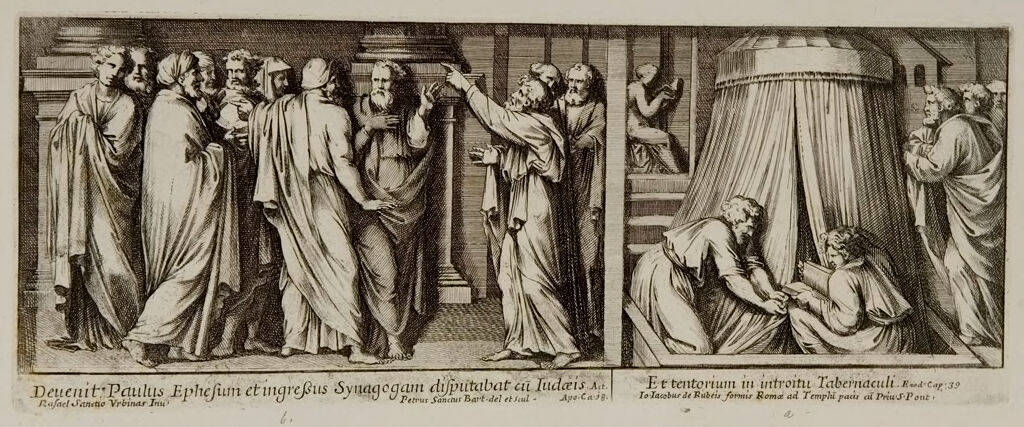
Saint Paul at Ephesus; Saint Paul Working as a Tentmaker, Pietro Santi Bartoli, (1635 – 1700)

Paul becomes friends with Aquila and Pricilla. They had two things in common: they were Jewish Christians, and they were tentmakers. Teachers typically did not do manual labor, but were compensated for teaching. Paul chose to do manual labor to relieve any burden from his house churches. This tells us some things about Paul’s life and his ministry:  He had tough and strong hands. He worked hard in the heat of the day; His shop likely became a place for conversations and conversions. He was constantly meeting people in Corinth. 

Every Sabbath he spoke to a hostile crowd. It was bad enough that he became frustrated with the Jews in the synagogue and was ready to move on. In the midst of these routines, God says to Paul in verses 9-10

Do not be afraid; keep on speaking, do not be silent. For I am with you, and no one is going to attack and harm you, because I have many people in this city.” 

All of this is to say, never underestimate the importance of your physical location. At work, home and in the community, God has placed many people around you. 

Posted in Uncategorized | Tagged , , , | Leave a comment

Acts 17 – Paul Faces the Intellectuals

 For as I walked around and looked carefully at your objects of worship, I even found an altar with this inscription: to an unknown god. So you are ignorant of the very thing you worship—and this is what I am going to proclaim to you. – Acts 17:23

Athens, Greece: the only place we know of where Paul did not establish a church. Maybe the Areopagus is like a combination of the Supreme Court and Congress gathering to discuss philosophy. Paul has taken the Gospel to the Jews and the Greeks. Now he goes to the intellectuals. There are Christians like that today, whose calling is to take the Gospel to intellectual skeptics. Here’s a clip of Wesley Huff a Christian apologist

Paul shows awareness of current philosophies. He has spent time understanding the Athenians’ religion: He describes one of their statues, and quotes one of their philosophers. He gets bold and refers to their ignorance and idolotry.

He is building bridges from their beliefs to the Gospel beliefs: God is invisible yet everywhere. There can be unity because God can be known by all. He has their attention until he proclaims the resurrection of Jesus. Then he is mocked by most, but he disciples the few who have listened and believed.

We must be knowledgeable of our beliefs and the beliefs of others. We must build bridges.

Posted in Uncategorized | Tagged , , | Leave a comment

Acts 17:10-34 – Varying Responses

They arrive in Beroea and like normally, begin preaching in the synagogue. The Bereans searched the scriptures to see if Paul’s word was true.

Troublemakers follow from Thessalonica, so they send Paul off to Athens where he’s deeply distressed to see the city full of idols. He proclaims Jesus and the resurrection. Some people believed.

When presented with the message, sometimes people believe immediately. Sometimes they say we’ll hear more later. Sometimes they express curiosity. Sometimes they scoff. Sometimes they join in the work.

Posted in Uncategorized | Leave a comment

Acts 16:16-40 – Paul Demands Justice for Himself

They have beaten us publicly, uncondemned, men who are Roman citizens, and have thrown us into prison; and do they now throw us out secretly? No! Let them come themselves and take us out.” (Acts 16:37)

I love the ending of chapter 16: The authorities wanted Paul and Silas set free. But, Paul says, not without justice.

He demands an apology because he and Silas were both Roman citizens who never should have been subjected to such treatment without a trial. The authorities give them an apology, lead them to the edge of the city, and ask them to leave in order to save face. Instead, Paul and Silas stick around for a while.

It reminded me of the movie IN THE NAME OF THE FATHER starring Daniel Day Lewis. Gerry Conton is one of four people falsely convicted of the 1974 Guildford Pub Bombings. After his exoneration, is asked to leave by the back door for “security reasons.” Instead, he goes out the front door to be in the public eye.

Posted in Uncategorized | Leave a comment

Acts 15:22-35: What is Necessary for Christians?

Paul sends a letter to the gentile churches to clarify that circumcision isn’t necessary. The “essentials” Paul lists are:

  • Refusing to eat food offerings to idols,
  • Blood
  • Meat from strangled animals
  • Sexual immorality

There must be a context because I can think of other essentials that seem like they would also be right, or I can see that nothing really is necessary at all to list. The whole point is the sacrifice of Jesus did the job. Not the sacrifice of Jesus plus not eating blood. I don’t understand why Paul adds anything at all.

I can see that the consciences of believers soften as they listen and trust and obey. So they should come to a conviction that sexual immorality (e.g.,) is inconsistent with relationship with God. It’s not a rule to follow. It’s a natural consequence of transformation in their minds and hearts. So I don’t understand why Paul doesn’t just trust the Spirit to convict.

Proverbs 16 1-3 speaks to this: people may be pure in their own eyes but the Lord examines their motives. –i see that we can deceive ourselves, but it does come out with humble submission in prayer.

We can’t control people. We have to trust them in their relationship with God that as they are committed to growth and that as God is delighted to transform them, they will make changes that align with their own consciences

Posted in Uncategorized | Leave a comment

Acts 15:1- Theological Controversy

Acts 15’s gathering of the church’s leaders preserved unity. It prevented a segregation of two different churches: one for gentiles and one for Jews. Unity is easy to propose, but as history demonstrates is hard to achieve, and very difficult to maintain.

The controversy centered on one question: Do gentile believers in Jesus observe the Torah as do the Jewish believers?

Their Bible was the Greek translation of the Old Testament. It stated explicitly that circumcision was an everlasting covenant requirement for all, including gentiles (Genesis 17:1–14). During that time converts to Judaism were required to be circumcised, so it was reasonable to follow the precedent that was already at work. What changed their minds? It was the testimonies.

Gentiles were receiving the Gospel and were receiving the Holy Spirit without circumcision. The eunuch in Acts 8 and Cornelius in Acts 10 are prime examples of the Holy Spirit doing a new work, one that transcended traditions.

Posted in Uncategorized | Leave a comment