Justice and Public Shame

Justice and Public Shame

This story is not an isolated incident – judges in several states are using public shaming as part of the sentence.  Thieves are forced to carry a sign in front of a stores. Other convicted criminals carry signs with them wherever they go.  Others have to take out ads detailing their crimes.  A convicted murderer, in addition to serving time, was forced to carry a picture of the victim.

Some have called this excessive, others compare it to Nathaniel Hawthorne’s ‘scarlet letter.’

Some, including the judges who hand down these sentences, defend this practice, saying it is a form of justice as well as a crime deterrent.  Is this biblical justice?  In the Old Testament law we do see public spitting as a form of public disgrace — usually for adultery, divorce, or not caring for a brother’s widow.   In some cases the offender was banned from the camp for a period of isolation.

Read this story and consider whether or not public shame is a just punishment for crime.

Posted in Uncategorized | 6 Comments

Did Jesus Know Everything?


The Gospels present us with a rather serious theological challenge. If Jesus is divine as well as human, isn’t it reasonable to expect him to know everything? If the Son of God ’emptied himself’ (Phil.2:7) to take on human flesh, does this mean he gave up his omniscience?

At times the Gospels tell us that Jesus knew people’s thoughts (Matt.12:25, Luke 5:22, Luke 6:8), but we also see occasions when Jesus’ seems to have limited knowledge. As a child, He “increased in wisdom and stature” like any other human (Luke 2:52). This alone implies he acquired great wisdom in the Scriptures through study, not through divine osmosis. Throughout the Gospels Jesus tries to find privacy, but is unable to do so (Mark 7:24). Isn’t Jesus supposed to know everything before it happens?

When in the midst of a crowd a sick person touches His clothing, He expresses curiosity as to who she is (Luke 8:45). Jesus explicitly denies any knowledge of the time of the Last Day (Mark 13:32). This verse has always been especially difficult to understand. If Jesus was God, how could He be ignorant of the time of His second coming?

This is the mystery of the divine/human nature of Christ. In the Gospels, we see frequent evidences of His humanity (He grew weary, suffered pain), but also many evidences of deity (His virgin birth, His resurrection and ascension, as well as His perfect words and deeds). Still, shouldn’t Jesus of Nazareth have known all of the answers?

Posted in Uncategorized | Tagged , , | 4 Comments

Does God Get Angry?

Historic Christianity believes that Jesus satisfied God’s wrath against sinners on the cross. We find in Scripture (Rom. 3:21–25; Heb. 2:17; 1 John 2:2; 4:10) that Jesus offered Himself as an atoning sacrifice, which removed our guilt and turned God’s wrath away from us. As a result, we are reconciled to God.20120416-212000.jpg

This is a foreign concept in the modern American church. Many do not believe God displays wrath, let alone gets angry. If God does not get angry at sin, can we still believe He is righteous, good and holy? If God does get angry at sin, does this make Him less righteous, good and holy?

Posted in Uncategorized | Tagged , , | 8 Comments

‘Doubting Thomas’, a Model for Modern Faith?

Thomas is often infamously remembered as “Doubting Thomas,”  but is this an accurate label?  Indeed Thomas refused to accept Christ’s resurrection without physical evidence, but how does that set him apart from the others mentioned in the Gospel accounts? 

Image

Doubting Thomas, by Guercino

Mary Magdalene thought that someone had stolen Jesus’ body before she encountered Jesus in person (John 20:2).  When she brought the news to the 11 disciples, they thought she was crazy (Luke 24:11).  Jesus rebuked all of the disciples — not just Thomas — “for their lack of faith and their stubborn refusal to believe” (Mark 16:13–14).  In what might have been Jesus’ last appearance before his ascension there were still “some who doubted” (Matthew 28:17).   Other than the single attention he gets in John 20:24-25, why label Thomas in such a way?

Thomas serves as a wonderful model of modern faith.  Instead, many Christians hold him up as a negative example because of his initial doubts.  He expressed his doubts fully and openly, unlike many Christians today.  When Jesus answered these doubts, he gladly believed.  His doubts were not arrogant, rebellious or self-centered, but rather his doubts had a greater purpose—he wanted to know the truth.

When we struggle with doubt, should we take encouragement from Thomas?  Is it right to ask God to prove Himself to satisfy our doubts?  Or must we take whatever He chooses to offer us and be content with it?  Consider the stories of Gideon’s fleece (Judges 6:36-40), Elijah’s test (1 Kings 18:16-39), and yes — Thomas.

Posted in Uncategorized | 5 Comments

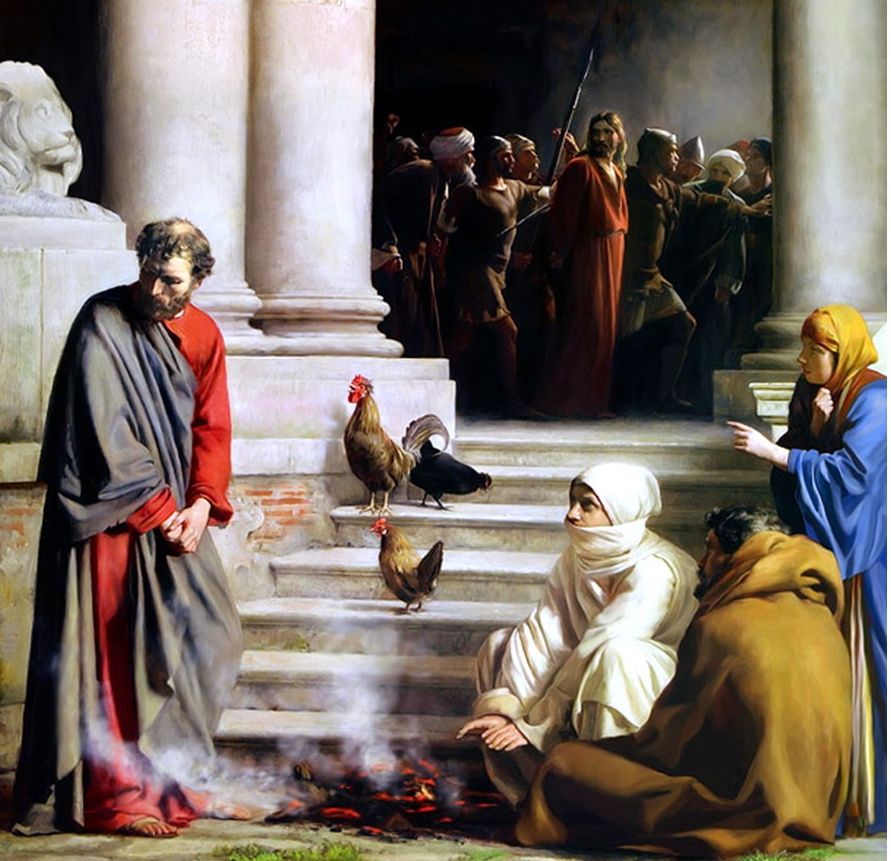
Two Charcoal Fires, Two Peter’s

Image

Peter's Denial, Carl Bloch

Peter warms himself next to two charcoal fires in the last chapters of John’s gospel:  In the court of the high priest where he denied Jesus, and having breakfast with Jesus after the resurrection (read John 21:15-19).

Peter must have thought that glance across the courtyard was the last time he would see Jesus, but the resurrection is the good news of second chances.  Jesus doesn’t stay dead, and Peter does not stay guilt ridden.  Peter renounced his discipleship in the high priest’s courtyard, but at breakfast Jesus reinstates him.

Resurrection means another charcoal fire, a meal with Jesus, and reconciliation —  for all of us.

Posted in Uncategorized | 1 Comment

Jesus descended into hell?

Christians have long been troubled over what these words in the apostle’s creed actually mean.

20120406-220412.jpg

Christ in Limbo, Fra Angelico

1 Peter 3:19 says that Jesus preached to those “spirits in prison” who had been disobedient in Noah’s day. If “prison” equals “hell,” then why should these people be singled out for such an honor, and who, if anyone, did Christ save with his preaching in hell? Also, Jesus could not have come only to take the “righteous men” from hell, for they were already separated from the condemned, as demonstrated in the story of the beggar Lazarus and the rich man in Luke 16.

Many Roman Catholics resolve this problem by saying Christ descended to two places—hell and purgatory—and that his purpose in each was different. In hell, he put unbelievers to shame, while in purgatory, he gave sinners hope for glory and the righteous deliverance.

Other Christians believe Christ descended to hell, but offer no clear cut explanation for the event. We may never be certain on this side of eternity what Christ did between the cross and the resurrection, but we do know from His own lips that He was in Paradise between His death and resurrection (Luke 23:43).

Posted in Uncategorized | 5 Comments

The Compassion of Judas Iscariot

Last Supper, by Carl Heinrich Bloch

The name of Judas Iscariot went down to the pages of history as the man who betrayed Jesus. Luke attributes this to Satan.  Matthew and Mark say it was because of greed.  John points to both, and also adds theft as a motivation (John 12:1-8).  I think if we could travel back in time to the first century and actually see Jesus and His disciples, we wouldn’t see Judas Iscariot as the sinister man we would suspect. In fact, he might even appear to be compassionate.

For example, when Mary began to wipe Jesus’ feet with expensive perfume Jesus was deeply touched, but it was Judas who pointed out that this costly perfume should have been sold and the money given to the poor (John 12:1-8). Those listening may have thought, “That’s a good point.  You know, Judas is a good steward, and he has his priorities straight.”

John, of course, reminds us that people are not always as they appear.  As Jesus would say, people will eventually know us by the fruit we bear (Matthew 7:16, 12:33; Luke 6:43-44).

Posted in Uncategorized | 8 Comments

Md. Lottery Officials: Winning Ticket Unclaimed

Md. Lottery Officials: Winning Ticket Unclaimed

Lottery ticket sales are big business, and proceeds from the Maryland Lottery support services and programs such as education, public health and public safety.  What could possibly be wrong with this?

Scripture does not explicitly oppose gambling, but are there biblical principles that could apply here? Consider the parable of the talents (Matthew 25:16) for an example of biblical stewardship.  Another question to consider: Is gambling a personal matter, or are we responsible for its social effects?  Studies have linked gambling to addiction, poverty and crime, but does that make purchasing a lottery ticket a bad thing?  Lottery tickets are a path to quick riches (for the one-in-176 million), but where else might this path lead? (1 Timothy 6:7–10)

Posted in Uncategorized | Leave a comment

Bodily Christianity

Spiritual growth. Spiritual formation. Spiritual. I use these words because I think they’re important, because I think we neglect these. But let’s not forget the body. Next week we remember our God who took on a human body, and subjected this body to torture and death. And of course, this same body was raised again to life. Judging from the numerous biblical references to the body (both Jesus’ and ours), what exactly does spirituality mean to a Christian? Paul’s words in Ephesians 2:1-10 are worth considering.

Posted in Uncategorized | 1 Comment

Zip line 2.0

Julie’s dad worked hard this week to get this running again. Do we have the coolest parsonage or what?


Zip line 2.0

Posted in Uncategorized | Leave a comment