Useless Prayers

Jesus himself came up and walked along with them; but they were kept from recognizing him. – Luke 24:15-16

In healthy relationships, there is a gradual increase of mutual knowledge and trust, a growing awareness of the other’s wishes, feelings and motivations in an atmosphere of caring and empathy. Do our prayers reflect these?
Walk-with-the-Lord

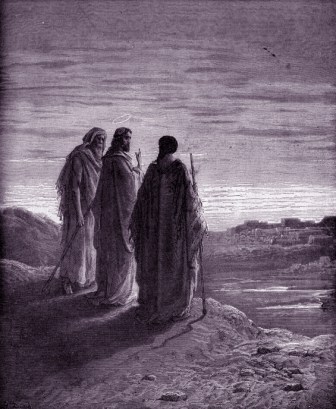
The Journey to Emmaus, Gustave Dore

A non-relational approach to prayer might go like this: We pray, and God either does or does not grant our request. Even a request that we desperately desire may be rejected, without explanation. Maybe this is because if it does not conform to God’s plan which we are not privileged to know.This approach to prayer has neither open two-way communication nor a gradual increase of understanding.

This is sad, given God’s desire to relate to humankind. God walked with Adam in the garden. God conversed with Abraham (Genesis 18:22-33) and Moses (Exodus 3-4). God literally lived among his people – in the tabernacle in the wilderness (Exodus 29:45) and in the person of Jesus Christ (John 1:14).

How can we make prayer more of a conversation? For a more substantive answer, I refer you to Ignatius Loyola, whose writings on conversational prayer have influenced thousands.

For a short answer, I suggest taking the revolutionary step and stop talking. Sit in silence, clear your mind of all thoughts and expectations of what prayer should be like, and listen.

Posted in Uncategorized | Leave a comment

Why the Two Pilates?

“‘What is truth?’ retorted Pilate.” – John 18:38

Christians, beware of using the Passion story as your only source for history.

In Passion plays and movies, Pilate is often portrayed as weak, vacillating and intimidated by a bloodthirsty mob. He agonizes over the situation, and eventually washes his hands of any responsibility for Jesus’ death to avoid a riot. But there’s more to Pilate.

1. According to the Jewish historian Josephus, when Pilate brought images of Caesar on Roman shields and standards into Jerusalem, protesters gathered. He threatened to ”cut them in pieces, and gave intimation to the soldiers to draw their swords.” The Jewish protestors refused to budge, and Pilate eventually relented.

tintoretto-1566x

Christ Before Pilate, by Tintoretto 

2. Josephus records that Pilate built an aqueduct using temple treasury money. When protestors gathered, he had soldiers dress like common men, “gave the signal from his tribunal, and many of the Jews were so sadly beaten, that many of them perished by the stripes they received.”

3. Philo, a Jewish philosopher, described Pilate’s “…corruption, his cruelty, and his continual murders of people untried and uncondemned.”

4. Luke mentions the “Galileans whose blood Pilate had mixed with their sacrifices” (13:1).

5. According to John, a detachment (speira) of soldiers accompanied Judas and temple officials at Jesus’ arrest. The Greek word speira is a cohort of 600 Roman soldiers, who would have been under Pilate’s command.

With these points in mind, I read the Pilate in the Passion story differently. He agonizes over the Jesus situation, sees Jesus as a threat but uses him as leverage. When he sentences Jesus to death, he is asserting his power over the Jews, not relinquishing it. He takes a beaten, bloody insurrectionist, dresses him up like a king and presents him to the Jewish aristocracy. The conversation goes like this in John 18:

Pilate: “Shall I crucify your king?”

Chief Priests: “We have no king but Caesar.”

That was precisely Pilate’s point.

Posted in Uncategorized | Leave a comment

Where Would Jesus Shop?

“But seek first his kingdom and his righteousness, and all these things will be given to you as well.” – Matthew 6:33

374579_2491465880776_1076626381_2607625_2145315956_n

As I prepare Lenten sermons, I’m reminded of  a book I read a few years ago: Consumed, by Benjamin Barber. 

Long gone are the days when the US economy was built around selling goods like timber, wool and wheat that served actual needs. Marketing professionals now search for new ways to reinvent and recreate goods in order to sell more stuff. Today’s consumerist economy is sustained by creating desires, convincing us to purchase anything from the latest smart phone to a bazillion different kinds of mustard.

I’m especially struck by Barber’s recollection of a time when he purchased bottled water. Bottled water, in a country where clean water flows straight from the tap, is a prime example of a manufactured need. “Over a billion people are without drinking water. ”Why don’t we find out ways to get the water they need to them, instead of new ways of getting water to us?”


Posted in Uncategorized | Leave a comment

Does Slavery Still Exist?

While at the Rock Retreat in Ocean City, I  attended a breakout session led by Brian Cress, Director of Youth Mobilization at International Justice Mission. IJM is a human rights agency that secures justice for victims of slavery, sexual exploitation and other forms of violent oppression. IJM lawyers, investigators and aftercare professionals work with local officials to ensure immediate victim rescue and aftercare, to prosecute perpetrators and to promote functioning public justice systems. child-carrying-water.jpg

They take literally Christ’s call “to proclaim good news to the poor” and “to proclaim freedom for the prisoners.” It was truly an eye opening experience. Have a look at their website. 

Posted in Uncategorized | Leave a comment

Should We Market the Church?


I’ve just finished reading Selling Out the Church: The Dangers of Church Marketing, and I think it provides a helpful warning to churches who want to grow. Philip Kenneson and James Street say that church marketing does more than change a church’s style, but their substance as well. Because church marketing defines the purpose of the church in terms of attracting the surrounding community, the market oriented church focuses on effectiveness and customer satisfaction, rather than what the vision for what the church ought to be: “a sign, a foretaste, and a herald of God’s present but still emerging kingdom.” church-signs

To be true to its nature and purpose, churches should stop thinking attractional (“Come and check us out”) and start thinking missional. In a post-Christian culture where many have no understanding of the basic Christian message and do not identify with the traditional Christian subculture, churches are forced to step out of their buildings, and take the Gospel into their diverse communities. Some of Jesus’ most revealing interactions are not with the temple authorities, but with the Gentiles, the poor and the outcast. The Kingdom of God typically lies outside existing religious structures.

Posted in Uncategorized | Leave a comment

Is A.D. The Bible Continues Biblically Accurate? (Episode 5)

The first followers of Jesus were met with brutal resistance by those who sought to destroy the message of the Gospel. A.D. follows the storyline of Acts and describes the hostility of the Jewish aristocracy, but seeks to balance that with the brutality of Rome and the violent activism of the Zealots.

They have created a fictional Pilate, whose increasingly exaggerated cruelty is probably wearing thin for most viewers. In episode 5 he orders the crucifixion of ten women, going far beyond artistic license and into the realm of morbid entertainment. (See my previous post on Pilate.)

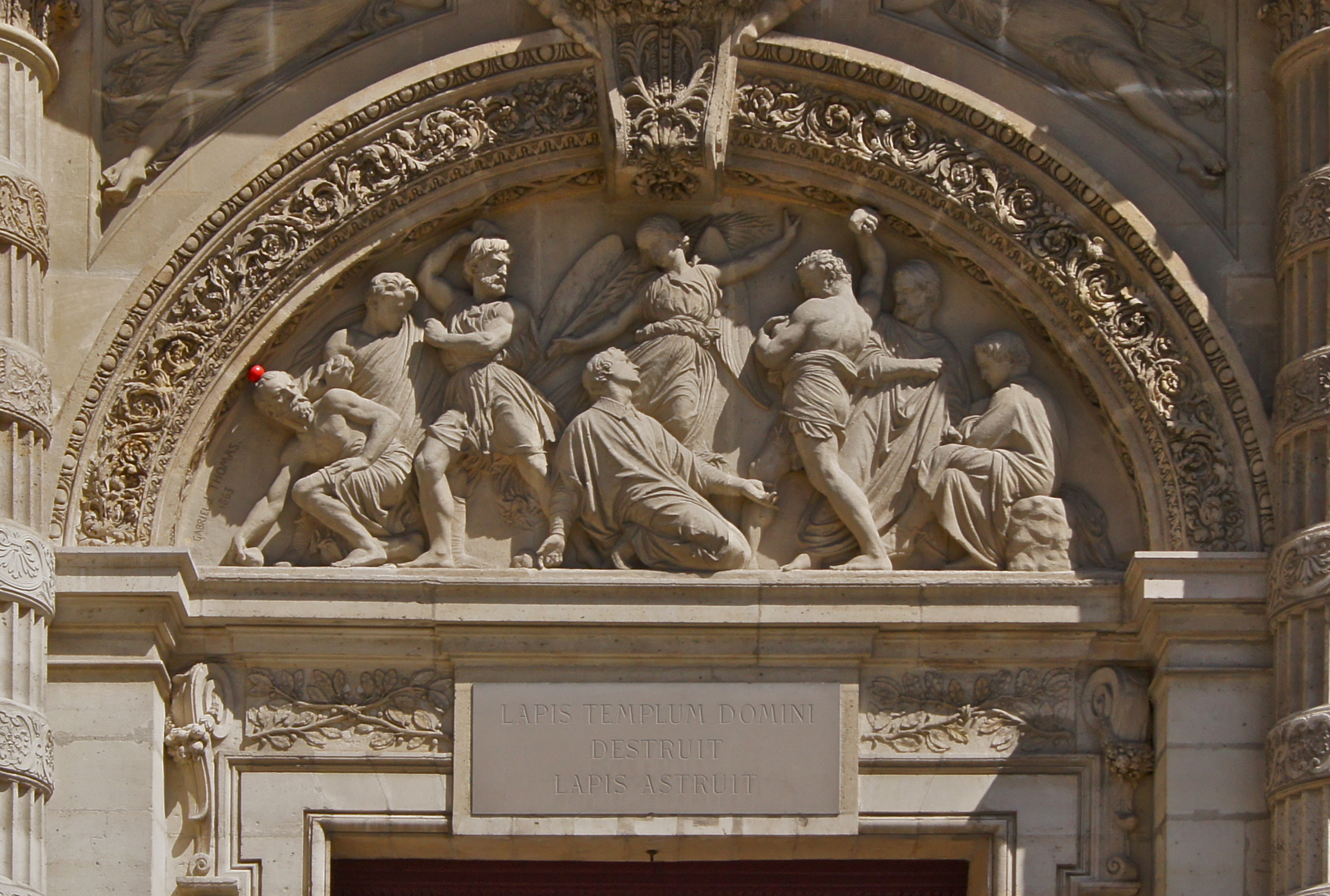
The stoning of St. Stephen,  by Gabriel-Jules Thomas

The stoning of St. Stephen, by Gabriel-Jules Thomas

Downey and Burnett do help us imagine the political atmosphere of the 1st century by developing a story of the Zealots (primarily the fictional Boaz), revolutionaries who wanted to violently overthrow Roman authority. Josephus, a 1st century Jewish historian, describes them as a violent deviation from mainstream Judaism, and holds them partly responsible for Rome’s eventual destruction of Jerusalem. A.D. provides a believable portrayal of this movement.

Pilate’s cruelty, Caiaphas’ hostility and the Zealots’ hatred serve as a contrast to the generosity, love and non-violence of the early Christians in episode 5.

Acts 2:42-47 briefly describes the early church’s shared way of life together, gathering daily for food, fellowship and teaching. Luke also tells us that they “were together and had all things in common,” so A.D.’s Christian encampment outside of Jerusalem is entirely believable. There we are able to imagine Jewish converts joining this growing movement and are introduced to Philip, who in Acts (and in A.D.) is one of the seven chosen to make sure food gets distributed to the widows (Acts 6:5).

In episode 5 we witness Stephen’s speech before the Sanhedrin, and his subsequent stoning. Like Peter’s speech in episode 3, we only get a few sentences of this, which severely waters down his message. We also see the Gospel message of love and forgiveness in the life of Boaz, although this is easily lost in the drama, action and suspense in the Caiaphas and Pilate stories.

A.D. has watered down the theology of Acts in favor of action, which from a production standpoint makes sense: most viewers want drama, action and suspense, not history and theology, in a television show.

The last scene gives us a glimpse of Paul. I’m looking forward to seeing how Downey and Burnett develop his character.

Posted in Uncategorized | Tagged , , , , , , , , , , | Leave a comment

Is A.D. The Bible Continues Biblically Accurate? (Episode 4)

While this TV miniseries is grounded in the Bible, some of it is pure speculation. Consider A.D.’s mostly fictional portrayal of Pilate, who orders that ten Jews be crucified for each day the zealot Boaz remains at large. How plausible is this?

The Message of Pilate's Wife, by James Tissot

The Message of Pilate’s Wife, by James Tissot

Philo, a 1st-century Jewish philosopher, tells us that Pilate once received a severe reprimand from Emperor Tiberius for installing Roman shields in the temple (see previous post), thus inciting rebellion and violating Rome’s policy of peaceful subjugation. Executing ten Jews per day (and forcing Caiaphas to eat cremated remains) would certainly provoke more anti-Roman hostility, not to mention the displeasure of the emperor.

However, both Philo and Josephus (a 1st-century Jewish historian), describe Pilate as a vindictive man with a furious temper, and Luke writes about the “Galileans whose blood Pilate had mixed with their sacrifices” (13:1). Pilate’s harsh retaliation to an attempted assassination is possible, although ten daily crucifixions seems to be excessive artistic license.

Still, this brutal description of Pilate better reflects the historical Pilate, and makes for better drama. That’s the Pilate you will see in episode 5.

Posted in Uncategorized | 1 Comment

Is A.D. The Bible Continues Biblically Accurate? (Episode 3)

No, strictly speaking. A.D. sometimes portrays persons and events that are not in the Bible.

A.D. the Bible Continues attempts to flesh out the story of the 1st century Church, and more fully develop characters like Pilate, Caiaphas and Jesus’ disciples. Anyone who has ever attended a Sight and Sound Theatre production knows that this requires artistic license. Still, some scenes in A.D.’s 3rd episode might seem a bit perplexing. For example:

Ecce Homo ("Behold the Man"),  by Antonio Ciseri

Ecce Homo (“Behold the Man”), by Antonio Ciseri

Peter and his daughter. Maya is not found in the Bible, but her appearance helps us imagine Peter the father (A.D. portrays him as widowed). Matthew 8:14 and 1 Corinthians 9:5 indicate that he did marry, so the character of Maya is a believable one.

Herod Antipas and Herodias. Luke 23:6-12 tell us that Herod attended Passover during Jesus’ trial, but says nothing about his returning for Pentecost. It is entirely possible that he did, so his processional into Jerusalem in episode 3 is not a complete stretch in imagination.

However, there are some problems with A.D.’s Herod. Luke tells us that Herod and Pilate became friends (v.12), while A.D. portrays them as enemies. Also, A.D.’s Herod considers himself the guardian of the Temple, even though he ruled in Galilee, not Judea.

Pilate. Vincent Regan (remember him from that awful movie 300?) is a pretty convincing Roman tyrant, but A.D.’s Pilate requires some imagination. We do not know that he attended the feast of Pentecost in A.D. 30, corrupted the Jewish temple or killed eyewitnesses to the resurrection. However, these actions do reflect the Pilate of history, who brought Roman eagle standards into the temple, used temple money to build an aqueduct and ordered his soldiers to randomly beat and kill Jewish protestors.

Pentecost. Acts 2 focuses on the filling of the 12 and Peter’s Pentecost sermon, but A.D. dwells on Pilate’s brutality, and Caiaphas’ and Herod’s scheming. This is unfortunate, but this is Hollywood.

If you want a Bible movie without the artistic license, I recommend The Gospel of John. If you don’t mind it, then A.D. The Bible Continues does a pretty good job at building drama, suspense and action. Isn’t that what television viewers want?

Posted in christianity, entertainment, religion | Tagged , , , , , , , , , , | 2 Comments

Did Jesus Exist? (Part Two)

This is a continuation of my last post, where I began a critique of an article entitled 5 Reasons to Suspect Jesus Never Existed.

3. Even the New Testament stories don’t claim to be first-hand accounts.

This is true, but this doesn’t mean they can’t be trusted. Both Luke (1:3) and John (21:24) assure their readers that their Gospels are based on eyewitnesses. Bishop Papias (60-130AD) and other early church writers claim that Mark derived his story from the Apostle Peter. Those sound like pretty good sources.

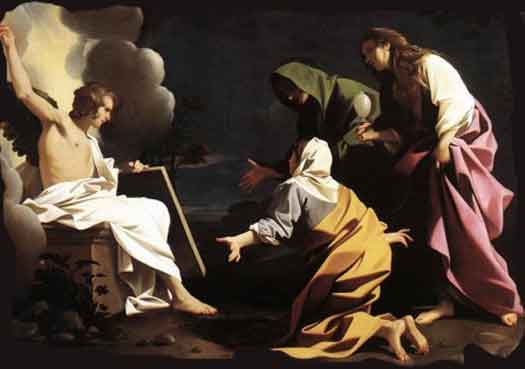
Bartolomeo Schedoni, The Two Marys at the Tomb

The Two Marys at the Tomb, by Bartolomeo Schedoni

Modern scholarship rejects the consensus of the 2nd century church, that Matthew and John wrote the Gospel that bear their names. If the early church was correct, then two of the Gospel writers are first-hand accounts.

4The gospels, our only accounts of a historical Jesus, contradict each other.

Sometimes the stories are different, but are these contradictions? For example, Mark claims that Jesus appeared to Mary Magdalene, while Matthew records that there was more than one woman. There is a difference between a partial report and a false report. In this case, Mark and Matthew are giving complimentary, not contradictory accounts.

Other differing accounts in the Gospels (most contain trivial details), can be explained in similar fashion. The early church recognized this.

5. Modern scholars who claim to have uncovered the real historical Jesus depict wildly different persons.

These scholars do not believe that the Bible is inspired by God, so any supernatural claims must be myths. These scholars cannot agree on what is myth and what is history in the Gospels, and they interpret these so-called myths in different ways. How could they possibly discover the same Jesus?

Skepticism is nothing new to Christianity. In the words of the Apostle Paul, “we preach Christ crucified: a stumbling block to Jews and foolishness to Gentiles, but to those whom God has called, both Jews and Greeks, Christ the power of God and the wisdom of God (1 Corinthians 1:23-24).”

Posted in Uncategorized | Tagged , , , , , , , , , | 3 Comments

Did Jesus Exist? (Part One)

As a Christian, my beliefs are grounded in history. I believe in the Jesus who was born in Bethlehem, performed miracles in Galilee and Judea, and died and rose again in Jerusalem.

Which is why an article entitled 5 Reasons to Suspect that Jesus Never Existed naturally caught my attention. To be faithful witnesses, Christians must listen to their critics, consider their arguments, and respond to them with intellectual honesty. In regards to this article, I’ve attempted to do just that in this 2-part series.

Christ Cleansing the Temple, by Carl Heinrich Bloch, 1875

Christ Cleansing the Temple, by Carl Heinrich Bloch, 1875

1. No first century secular evidence whatsoever exists to support the actuality of Yeshua ben Yosef (the Aramaic name for Jesus the Nazarene).

I see two problems with this argument. First of all, this statement implies that historical claims made by 1st Christians cannot be taken seriously. Only those made by writers outside the Christian community can serve as solid historical evidence.

Secondly, Christianity was originally a small Jewish sect, so it doesn’t surprise me that Jesus doesn’t appear in 1st century histories outside of the Christian tradition. That being said, there are extra-biblical mentions (however brief) of Jesus Christ in ancient writings, such as Josephus, Tacitus and Pliny the Younger to name a few.

2. The earliest New Testament writers seem ignorant of the details of Jesus’ life, which become more crystalized in later texts.

Aside from Paul’s account of the Last Supper, the earlier New Testament books provide few historical details of Jesus’ earthly life (the Gospels were among the last to be written). Paul admits that he is not an eyewitness like the Apostles. He credits his conversion to an encounter with the risen Christ while traveling to Damascus, an account that skeptics will quickly dismiss as fanaticism or fable.

Does an absence of historical details mean ignorance?

Paul is writing as a theologian and a pastor, not an historian. He is concerned with answering questions of theology, rebuking bad behavior, and encouraging the churches he had planted. It doesn’t surprise me that he doesn’t provide many historical details about Jesus.

If our salvation depends on the Jesus of history, these are important criticisms to answer.

(Part 2: Eyewitnesses, contradictions, and modern New Testament scholars)

Posted in Uncategorized | Tagged , , , , , , , , , | Leave a comment