My 4:17 (The New American Bible) reads, to stop this from spreading further…we must give them a stern warning never to mention [Jesus’] name to anyone again. I think it’s so interesting how threatened the religious leaders were. I guess they wanted to hold on to their own sense of control or power. Hilarious that they thought they could squelch it with a stern warning.
Then Peter said, “Silver or gold I do not have, but what I do have I give you. In the name of Jesus Christ of Nazareth, walk.” Acts 3:6
The lame man asked for what he wanted; he received what he needed. Don’t settle for what you want from God. When God meets your needs, he may not give you what you asked for, but what he provides will always be greater than what you wanted.
Fifty days after Passover, or in church language, Holy Week, God’s Spirit creates a radically reshaped community. We call this the Day of Pentecost, while Jews named it the Feast of Weeks, named for the first-fruits of the harvest (cf. Leviticus 23:15–21). The believers who were gathered welcome the fresh arrival of the Spirit and the empowering of all Christians. Peter preaches the good news about Jesus’ resurrection and ascension, and 3,000 believed and were baptized.
We can’t skim over the opening of Acts 2: “they were all together in one place” (2:1). Rather than say “they were together” or they were “all in one place,” Luke triples it: “all” and “together” and “in one place.” Never estimate the powerful potential when believers in Christ gather. Two words that come to my mind in this passage are uncontrollable and unpredictable. We can’t predict or control what the Holy Spirit will do. When we gather, obey and pray, we put ourselves in a place where God can work.
The first Christians lived communally (2:44–45). They voluntarily shared with each other. How can the Gospel rearrange everything—our economics, our relationships and our attachments?
I’m listening to a lot of podcasts lately about the historicity of Christianity. That Luke writes a letter to a person about his experiences in real life feels powerful to me. God cares about this temporary reality and gives meaning to it by participating in it.
Luke is like–this happened, and these people witnessed it and while we watched, we saw this, and it’s really really real. I want you to know it’s really really real!
How to help others experience the power of the message? All we can do is present content and pray that the Spirit of God will do the magic work of giving understanding and transformational power to the ones who we tell.
On May 1 I invited Mount Zion United Methodist Church to a 40 day Bible reading challenge.
The same Luke who wrote the 3rd Gospel also wrote Acts. It’s a sequel, so he continues where he left off: the disciples are waiting. To know about Jesus, is not enough. We need to experience His power, so we wait, pray and discern.
They replace Judas Iscariot, by rolling dice? That’s a pretty big decision to leave to a game of chance. We should look at what’s going on in our churches and communities, but why not just pray? The practice of casting lots does disappear from the Bible, so maybe the apostles felt they needed confirmation for a fledging church with a crucial leadership position to fill.
Casting lots was a method used in ancient times to make decisions or determine God’s will. But Peter also prays, “Lord, you know everyone’s heart. Show us which of these two you have chosen.” Like the Hebrew proverb goes, ” The lot is cast into the lap, but its every decision is from the Lord.” (Proverbs 16:33].
Are we experiencing the power of Christ? Are we able to listen and discern God’s will?
Who, being in very nature God, did not consider equality with God something to be used to his own advantage; rather, he made himself nothing by taking the very nature of a servant, being made in human likeness. And being found in appearance as a man, he humbled himself by becoming obedient to death— even death on a cross! – Philippians 2:6-8
The Gospels present us with a theological challenge. If Jesus is divine as well as human, did he know everything? If the Son of God emptied himself (Phil.2:7) to take on human flesh, did he give up his omniscience?
At times the Gospels tell us that Jesus knew people’s thoughts (Matt.12:25, Luke 5:22, Luke 6:8), but we also see occasions when Jesus’ seems to have limited knowledge. As a child, He “increased in wisdom and stature” like any other human (Luke 2:52). This alone implies he acquired great wisdom in the Scriptures through study, not through divine osmosis. Throughout the Gospels Jesus tries to find privacy, but is unable to do so (Mark 7:24). Isn’t Jesus supposed to know everything before it happens?
When in the midst of a crowd a sick person touches His clothing, He expresses curiosity as to who she is (Luke 8:45). Jesus explicitly denies any knowledge of the time of the Last Day (Mark 13:32). This verse has always been especially difficult to understand. If Jesus was God, how could He be ignorant of the time of His second coming?
This is the mystery of the divine/human nature of Christ. In the Gospels, we see frequent evidences of His humanity (He grew weary, suffered pain), but also many evidences of deity (His virgin birth, His resurrection and ascension, as well as His perfect words and deeds). Still, shouldn’t Jesus of Nazareth have known all of the answers?
Do not put your trust in princes, in human beings, who cannot save. When their spirit departs, they return to the ground; on that very day their plans come to nothing. Blessed are those whose help is the God of Jacob, whose hope is in the LORD their God. Psalm 146:3–5
Throughout Scripture we are reminded that God is sovereign over all things, including political affairs (Daniel 2:21, Romans 13:1-7); not just domestic but international (Acts 17:26-27). God raises up leaders and takes them down. In other words, whatever the election results, God is in control.
Psalm 146 is especially relevant as the political fervor increases after another election.
Just as the people of Israel were tempted to put their trust in the king’s sons, the next generation of leaders – the “princes” – so we are tempted to place too much hope in presidents, senators and congressional leaders. We are reminded by these verses, however, that human beings by themselves cannot save.
Throughout history there have been a wide array of political and social leaders in this country and planet. History tells us that politicians can provide leadership that helps ease pain for the suffering, improve order in chaos, bring justice to the marginalized and provide security for the vulnerable.
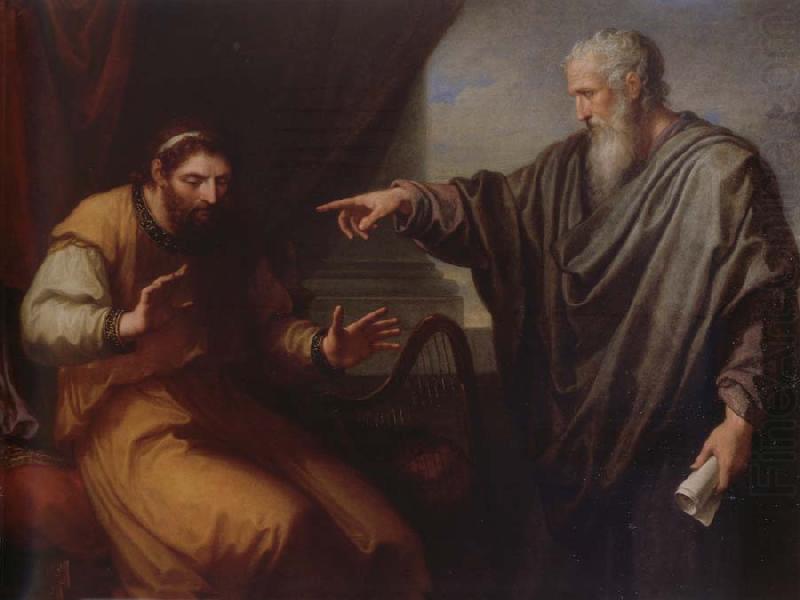
Angelika Kauffmann’s David and Nathan
But even when our politicians walk in integrity, they likely cannot live up to all of our expectations. They do not possess all wisdom, power, and benevolence. Our political leaders will make mistakes, their plans will be frustrated by political opposition, as well as the changing tide of popular opinion. Their hearts will be tempted by pride and the power entrusted to them. King David, who is described as a man after God’s own heart, tried to hide his abuse of power through adultery, and tried to hide it up with murder. You can read this sad episode in 2 Samuel 11-12.
Thus the caution in Psalm 146:3: Do not put your trust in princes, but rather, hope in the Lord.” The Psalmist goes on to say that God is the…
… “maker of heaven and earth, the sea, and everything in them, who remains faithful forever…upholds the cause of the oppressed…gives food to the hungry… sets prisoners free … gives sight to the blind … lifts up those who are bowed down … loves the righteous … watches over the foreigner … sustains the fatherless and the widow, but frustrates the way of the wicked” (Psalm 146:6-9).
Centuries before November 5th God established an eternal ruler in the person of Jesus Christ. In Isaiah’s words:
“He will be called Wonderful Counselor, Mighty God, Everlasting Father, Prince of Peace. Of the greatness of his government and peace there will be no end. He will reign on David’s throne and over his kingdom, establishing and upholding it with justice and righteousness from that time on and forever“ (Isaiah 9:6-7).
Be engaged with politics (especially at the local level) and be aware of political developments. Know the difference between news and commentary. Beware of the tribalism that pushes people into one group or another. Recognize our own unhealthy desire for power. Practice awareness, and know when expressing our political views allow us to create a negative climate for others. Pray daily for our elected officials, as they are incurably human. Hold them accountable, as they are charged with great responsibility. But do not be lured into placing too much hope in a political system, by embracing a political message that eclipses the Gospel of Jesus Christ.
He wanted to see who Jesus was, but because he was short he could not see over the crowd. Luke 19:3
As I prepare for this Sunday’s sermon about Zacchaeus, my mind keeps wandering. What was it like being short in biblical times? “Short” and “tall” are relative terms, but Luke tells us that Zacchaeus had to climb a tree in order to see Jesus, so his height created certain disadvantages for him. What other challenges might Zacchaeus have faced because of his height?
Did his career suffer? Did he ever have trouble getting a job, or getting a promotion? Did he experience unconscious bias from potential employers? I wouldn’t dismiss this possibility out of hand – usually the taller presidential candidate wins. Apparently Zacchaeus overcame this obstacle. He was eventually able to get a foot in the door, becoming a tax collector for the Roman Empire.
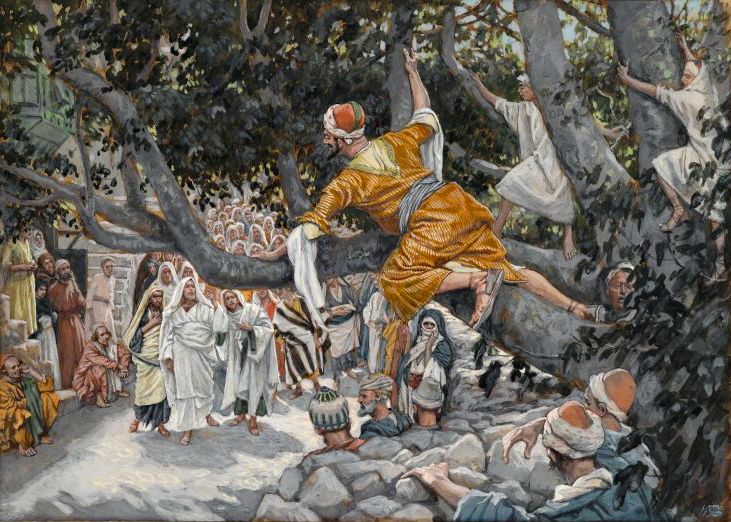
Zacchaeus in the Sycamore, James Tissot
Did his romantic life suffer? I realize that men didn’t exactly date in biblical times, but as the Italians say, height is half of beauty. Maybe the father of a potential bride disapproved of Zacchaeus, preferring a taller, more attractive man for his daughter?
If there were such things as resumes and applications back then, would Zaccheaus have been tempted to exaggerate his height, adding an inch or two when he thought he could get away with it? This would be understandable, since society often valorizes the tall and belittles the short.
If, as psychologists say, height and self-esteem are so enmeshed, what were the psychological consequences of Zacchaeus’ height? Did he view himself more negatively than his taller peers? Given the pervasive tendency to associate height with power, did Zacchaeus ever struggle with a sense of vulnerability?
Obviously there are no answers to these questions. But our tendency to prefer the tall over the short is undeniable: it’s embedded in our very language. We look up to people we consider superior; those without influence are the little people. Perhaps we see in Zacchaeus an example of who God calls and how God works. The Apostle Paul writes:
God chose the weak things of the world to shame the strong. God chose the lowly things of this world and the despised things—and the things that are not—to nullify the things that are, so that no one may boast before him. 1 Corinthians 1:27–30.
They were even watching the gates day and night to murder him, 25 but his disciples took him one night and let him down through the city wall by lowering him in a basket. – Acts 9:24
How do we know if a risk is wise or unwise, and which risks God is actually calling us to take?
The church should be playing a role in the choices we make regarding risks. Seek leaders in the church with gifts of wisdom and experience for advice on jobs, relationships, life patterns and ministry.
At every level, the Body of Christ can help us avoid stupid mistakes in our lives that would create unwarranted and unnecessary risks. None of us should live in a bubble where we are making all these decisions by ourselves. God has surrounded us with people who can help us.
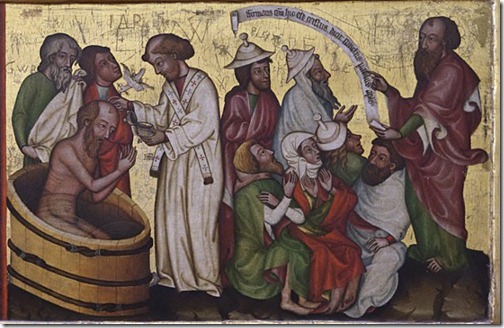
Böhmischer Altar, c. 1375-80
A foolish risk is one that is taken for something small. It is foolish for being unwilling to take a risk for something big. You could cal it the principle is proportionality. The bigger the expected outcome for the glory of God, the wiser it is to take a great risk. Likewise, the more insignificant and selfish the outcome, the more unwise it would be to take a big risk, because the return is so meager.
Here is a example I’ve heard. Someone will tell a foreign missionary, “You need to get out, because the situation is becoming very dangerous.” That’s a difficult choice. Some missionaries will agree and leave. Others will say, “No, we have identified with this people for many years. We die with them. We are staying.”
I think both of those choices can be right. Sometimes Paul stood and was stoned and sometimes he got in a basket and escaped. Only the Holy Spirit can make plain when we should do one or the other.
The Lord appeared to Abraham near the great trees of Mamre while he was sitting at the entrance to his tent in the heat of the day. Abraham looked up and saw three men standing nearby. When he saw them, he hurried from the entrance of his tent to meet them and bowed low to the ground.
a 13th century icon by Andrei Rublev called The Old Testament Trinity.
He said, “If I have found favor in your eyes, my lord, do not pass your servant by. Let a little water be brought, and then you may all wash your feet and rest under this tree. Let me get you something to eat, so you can be refreshed and then go on your way—now that you have come to your servant.”
“Very well, they answered, do as you say.” So Abraham hurried into the tent to Sarah. “Quick,” he said, “get three seahs of the finest flour and knead it and bake some bread.” Then he ran to the herd and selected a choice, tender calf and gave it to a servant, who hurried to prepare it. He then brought some curds and milk and the calf that had been prepared, and set these before them. While they ate, he stood near them under a tree.
This is also how we understand the inter-relationality of the Trinity. For Christians, God is the one who welcomes us to the table, welcomes us as strangers to the food and community of the Trinity. Hospitality is at the core of Christian identity and practice. It is one of our primary witnesses to our life together in Christ.







 The Other Six Days