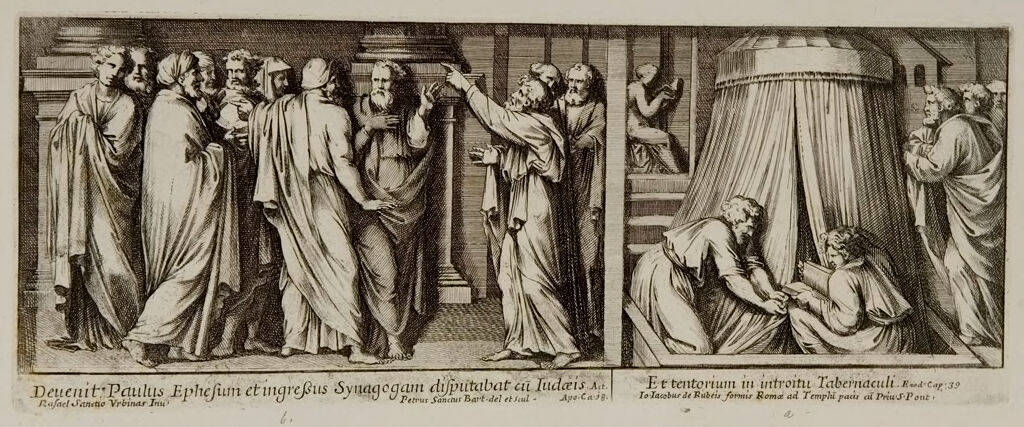
“…he was a tentmaker as they were, he stayed and worked with them” (Acts 18:3).
Saint Paul at Ephesus; Saint Paul Working as a Tentmaker, Pietro Santi Bartoli, (1635 – 1700)
Paul becomes friends with Aquila and Pricilla. They had two things in common: they were Jewish Christians, and they were tentmakers. Teachers typically did not do manual labor, but were compensated for teaching. Paul chose to do manual labor to relieve any burden from his house churches. This tells us some things about Paul’s life and his ministry: He had tough and strong hands. He worked hard in the heat of the day; His shop likely became a place for conversations and conversions. He was constantly meeting people in Corinth.
Every Sabbath he spoke to a hostile crowd. It was bad enough that he became frustrated with the Jews in thesynagogue and was ready to move on. In the midst of these routines, God says to Paul in verses 9-10:
“Donotbeafraid; keepon speaking, do not be silent. For I am with you, and no one is going to attack and harm you, because I have many people in this city.”
All of this is to say, never underestimate the importance of your physical location. At work, home and in the community, God has placed many people around you.
Where do we get our beliefs?
Three theological perspectives have significantly shaped my Christian identity: Evangelicalism, the early Methodist tradition and liberation theology.
From my coming to faith in a Baptist church and throughout my education in a Baptist school and college, I was nurtured by convictions that emphasized a spiritual rebirth, a personal relationship with Jesus Christ and the centrality of the Bible. Even when I disagree with certain aspects of evangelicalism, it has deeply influenced my sense of what it means to be a follower of Jesus Christ.
My seminary studies spawned my interest in early Methodism, particularly its approach to spiritual formation. Its leaders were convinced that only a foundation of doctrine and discipline would lead to a meaningful transformation of the heart and mind. In other words, having the mind of Christ enables me to be more like Christ.
Life in a suburban culture obscures the increasing gap between the poor and rich, as well as the Bible’s close identification with the poor. My doctoral work in socio-cultural context exposed me to liberation theology, which helps me see redemptive history as a history of oppressed groups, written from the perspective of the powerless, about a God who is actively involved with the poor in their struggles.
I am now the pastor at Mount Zion United Methodist Church in St Mary’s County, Maryland. Together my wife and I have 4 children.



 The Other Six Days